Caring for a Christmas cactus indoors is simpler than you think. You do not need a degree in botany or green thumbs; you just need to meet their specific, quiet needs. After ten years of growing these resilient plants in my cold Vermont home, I can honestly say the biggest secret is just patient consistency: water only when dry, provide bright indirect light, and let them rest in a cool, dark place to trigger those famous winter blooms.
I am not a professional grower. I am Aiden Hall, a home grower who simply loves these plants. The advice I share here is my own routine—what I do and what I have learned by observing my own plants, year after year, as they thrive on my windowsills while snow piles up outside. My goal is to make your Schlumbergera care feel simple, calm, and successful, just as I’ve learned to keep mine, by mimicking their natural home.
Meet Your Jungle Cactus (It Isn’t a Desert Plant)
Understanding how to care for a christmas cactus indoors starts with the single most common mistake: treating it like its arid cousins. Forget the hot, dry desert. A Christmas cactus, or more accurately Schlumbergera truncata or S. bridgesii, is a tropical epiphyte.
In the coastal forests of Brazil, it does not live in soil. It grows on other plants (without harming them), rooted in the moss and debris collecting in tree forks. Knowing this explains everything your plant wants from you: bright, filtered light, excellent drainage, and high humidity, not dry heat or dense dirt.
Getting the Name Right: Are You Sure It’s a Christmas Cactus?
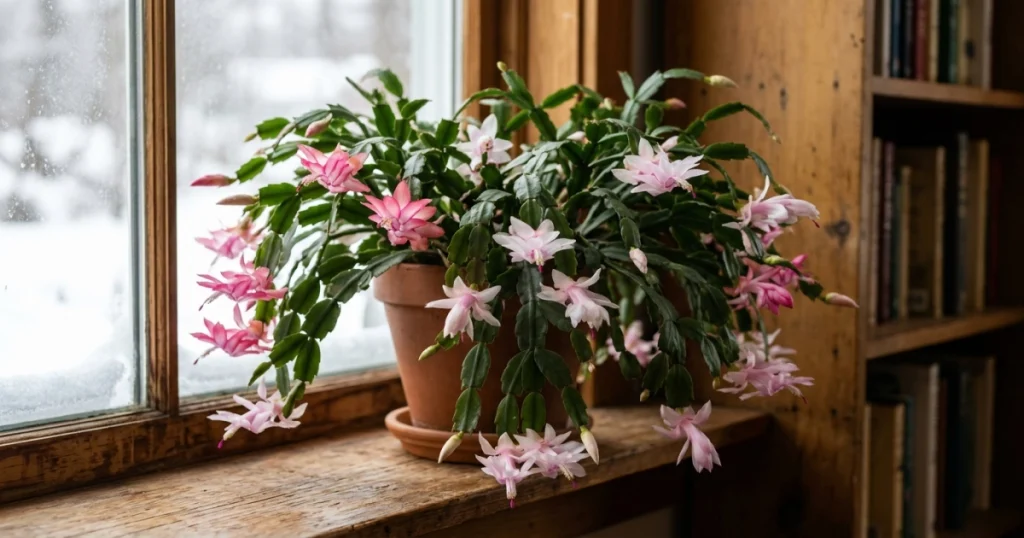
What we commonly buy might actually be a Thanksgiving cactus (S. truncata). My plants often bloom three separate times between November and March. They overlap, and honestly, the care is identical. Here is how I quickly tell my own apart by looking at their stems, or phylloclades:
- Thanksgiving Cactus (S. truncata): The segments are “toothed,” with noticeable, pointed claws along the edge. These tend to bloom slightly earlier, often naturally starting in November.
- Christmas Cactus (S. bridgesii): The segment edges are smoother, scalloped, or rounded. This is the older, traditional cross.
- Easter Cactus (Rhipsalidopsis gaertneri): Its segments are also smooth but possess fine bristles at the joints. Its flower is star-shaped, totally different from the Schlumbergera’s symmetrical, double-tube bloom.
I grow all three the same way. The name confusion doesn’t matter; the jungle origin is what counts.
My 4 Secrets to Simple Indoor Christmas Cactus Care
I have boiled down a decade of observations into four practical pillars. If you get these right, your plant will be happy.
1. Water with Observation, Not a Schedule
“How often do I water a Christmas cactus?” is the number one question on my Contact Us page. And my answer is always: When the soil is dry.
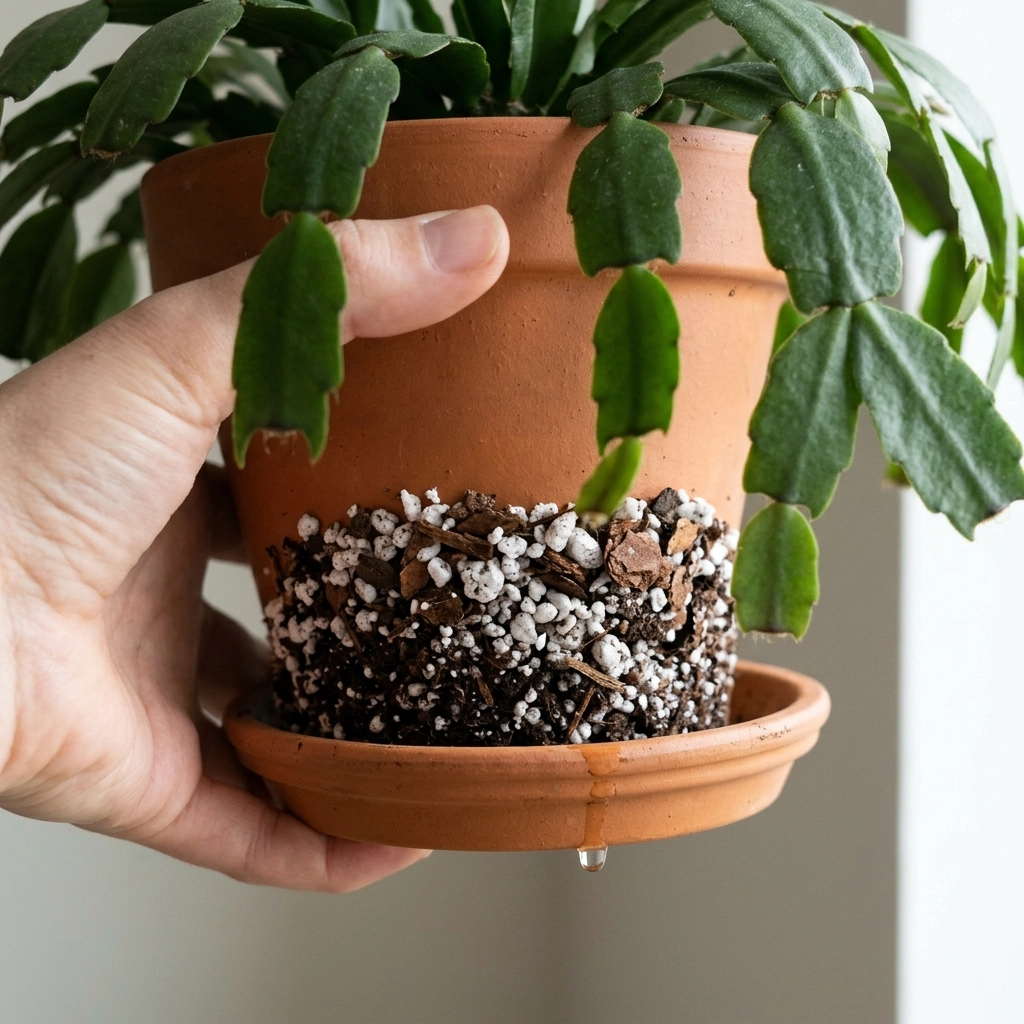
I have tried a schedule, and in my house, it is a disaster. The temperature and sunlight change daily. I check my plants weekly. I don’t poke a finger in; I lift the pot. When I know its “full” weight after a good watering, I wait until the pot feels surprisingly light. Then, I give it a thorough soaking in the sink, letting all the water drain away through the drainage holes. Never let your plant sit in water. Overwatering leads directly to root rot, a deadly, mushy issue I have learned to avoid with strict drainage.
A Note on Soil and Drainage
You must have drainage holes. My plants all live in a fast-draining, airy mix. My standard recipe is: 1 part quality indoor potting soil, 1 part perlite or pumice (the coarse white bits that provide aeration), and 1 part small orchid bark. I want a mix that is loose, light, and almost feels spongy, allowing air to reach the epiphytic roots and water to flow freely through.
2. Light: Not Too Much, Not Too Little
In Brazil, these plants receive “filtered light” from the tree canopy. For a home, this means bright, indirect light. Direct, scorching sunlight—especially from a south-facing window in summer—will burn the delicate segments, turning them yellow, reddish, or causing them to drop off.
I keep mine set back a few feet from an east- or north-facing window, where they receive hours of bright but soft light. If you have a south-facing window, you will need to buffer the intense sun with a sheer curtain. In winter, they are less fussy about sun and can sit much closer to the cold window glass.
3. Temperature and Humidity
In my experience at Christmas Cactus Cares, these plants thrive in moderate temperatures, preferring 65°F to 75°F (18°C–24°C) during the day. However, to bloom, they must have cool, dark nights (around 55°F/13°C) for six to eight weeks in early autumn, which I will explain in the blooming section.
Humidity is crucial. Coming from a Brazilian forest, they hate dry indoor furnace air in winter. To increase humidity, I use a simple pebble tray. I fill a tray with small stones and water, setting the pot above the waterline so the soil never touches the water, allowing evaporation to moisten the air. I do not mist, as misting can increase the risk of fungal issues on the stems.
4. Blooming: The Magic Recipe of Cool and Dark
This is where my Vermont routine comes alive. To make your Christmas cactus bloom, you must provide the proper cues. They flower in response to the naturally lengthening nights of autumn. This phenomenon is called short-day flowering, and it requires two specific triggers, beginning about 6–8 weeks before you want flowers (roughly mid-September for November blooms).
- Strict Darkness: The plant must have at least 12–14 hours of uninterrupted darkness every night. No table lamps, no streetlights, no peeking. My solution is simple: I move my plants into my guest room closet, where they rest in the cool dark from 7 p.m. to 8 a.m. If you do not have a dark room, you can place a cardboard box over the plant, creating a dark sanctuary.
- Cool Temperatures: They require cool nighttime temperatures, ideally between 50°F and 60°F (10°C–15°C). The cool air is essential. In Vermont, my guest room window is cracked, providing that exact chilling.
I do this routine for six weeks. Water very lightly during this “resting period.” When I see dozens of tiny buds (they look like little pinheads, changing shape overnight to a tiny teardrop), I move the plant once to its final blooming location and resume watering normally, letting the magic happen.
Bud blast, or sudden bud drop, is incredibly common if you move the plant once it has buds, or if it experiences sudden drafts, temperature changes, or light fluctuations. Be very gentle once you see those tiny buds.
Common Schlumbergera Troubles and How I Check Them
My plants are not perfect. In 10 years, I have seen almost every symptom. This table is my simple guide for checking symptoms, based on my own mistakes.
| Observation | Likely Cause | What I Check | My Adjustment |
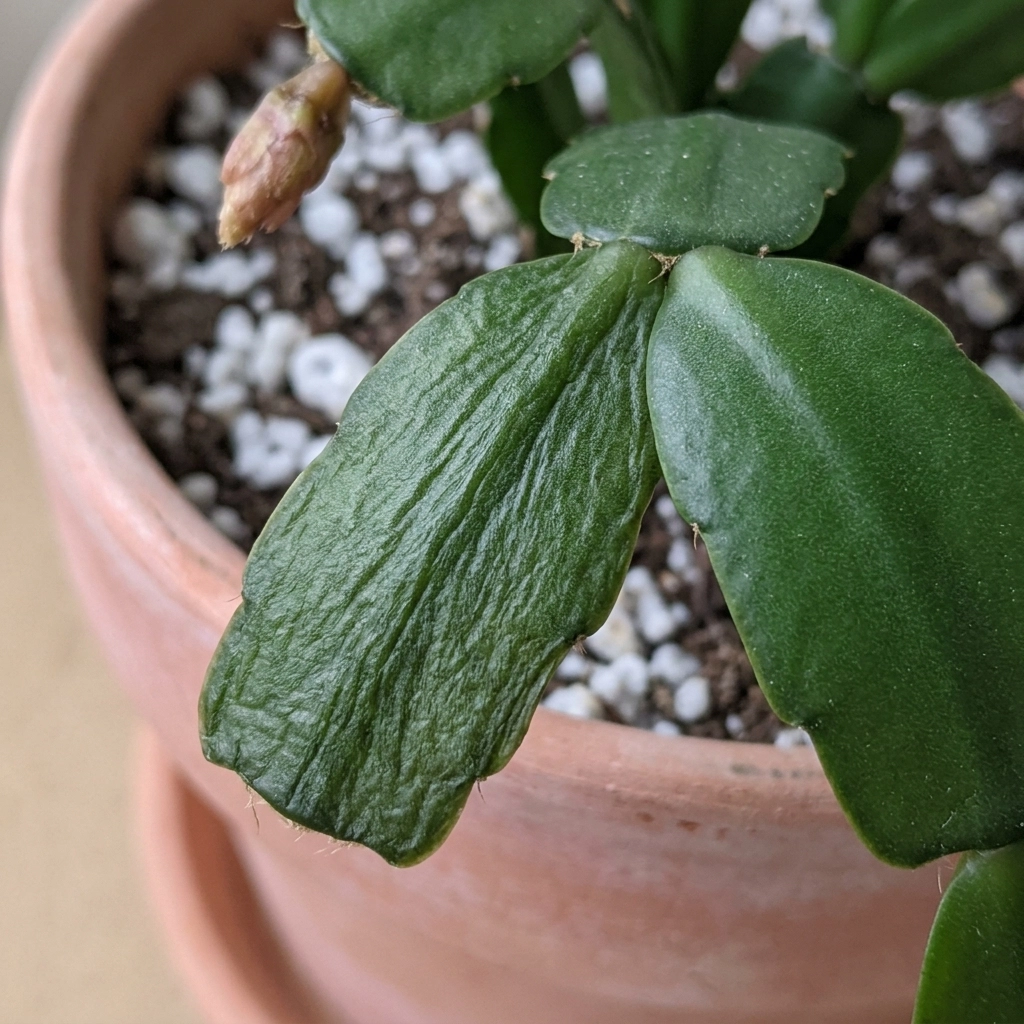
| Wrinkled segments | It is thirsty. (Separating observation from diagnosis.) | Soil moisture and stem firmness. If the plant feels light and stems are soft, water it. | Give it a thorough soak. If wrinkly AND stems are mushy, it’s root rot. |
| Yellowing segments | Overwatering (Root Rot). | Soil moisture and smell. If soil is wet and smells musty, root rot has begun. | Stop watering immediately. Allow the pot to dry completely. If severe, a repot in fresh, dry soil and pruning bad roots is the only chance. (This is when it may be already too late.) |
| Dropping segments (leaves) | Stress, often temperature. | Is it in a draft? Is it near a direct heat source? | Move it to a calm, indirect light location. The plant is shedding segments to conserve energy. |
| Bud drop | Bud blast (Sudden stress). | Did I move the plant? Did the light change? Is it by a door? | Be patient. Do not move a blooming plant. Bud blast is usually temporary; the plant will recover for next season. |
| Leaning significantly | Reaching for light. | Is one side facing the light source? | Rotate the pot 1/4 turn every other week to encourage balanced growth, especially in the growing season. |
| Reddish segments | Excessive sunlight or stress. | Look at the sun position. Is it getting harsh noon sun? | Move it further back from the window or provide a filter. A slight reddish hue is normal for some varieties, but a sunburned look means too much light. |
This table is for educational use only and not professional horticultural or expert advice.
Honest Talk: Common Mistakes I’ve Made
I wasn’t always successful. Here are my biggest “Aha!” moments from the early years, when I didn’t yet know what my plants needed.
- The Schedule Habit: I killed my first Christmas cactus by watering it every Saturday. I ignored the soil and just followed my calendar. It rotted from the bottom up. I will never do that again. Now, I let the pot’s lightness guide me.
- The Direct-Sun Mistake: I thought “cactus” and put it in a hot, sunny south window. Within weeks, its segments were pale yellow and soft. I nearly sunburned it to death. Since then, bright but filtered light is a hard rule.
- Moving it During Budding: This one hurt. I had a spectacular crop of buds and decided to move it for a dinner party so everyone could admire it. It immediately dropped every single bud. I learned the hard way that buds are exquisitely sensitive to sudden change. Be still.
- Assuming it needed a bigger pot: Christmas cacti love being slightly root-bound. I used to repot them into much larger pots, thinking I was giving them “room.” The excess soil just stayed too wet for too long, leading to a weak, floppy plant. They can stay in the same terracotta pot for 5 or 6 years, easily.
Is Your Christmas Cactus Saving or a Goner?
This is the hardest part. Sometimes, you cannot fix it.
If your plant is merely wrinkled from thirst, drooping, or has yellowed slightly from too much light, it is savable. Water it, or move it, and it will recover with patience (often taking several weeks to look full again).
However, if your plant is mushy, smelly, and entire stems have become soft and brown at the soil line, that is advanced root rot. I have found this is almost always too late. The internal tissue is black and dying. Your only option at this point is to look for healthy, firm green segments, cut them above the rotted area with clean snips, and try to root them in a dry perlite/soil mix to propagate a new plant. I treat the rotted parent plant with respect and compost it.
One Final Thought for Your Plants
You do not need to memorize a hundred rules. If you only look at one thing, look at your plant. If it looks full, green, and the pot is heavy, it’s fine. If the pot feels light or the segments start to look dull and wrinkled, look closer. That one habit of patient observation is the single best way I know to keep any Christmas cactus happy and thriving, year after Vermont year.
Frequently Asked Questions
What kind of soil do I use for a Christmas cactus?
I use a loose, airy mix that mimics their jungle home. My go-to recipe is 1 part indoor potting soil, 1 part perlite (the white drainage pebbles), and 1 part small orchid bark. Air needs to reach the roots, and water must drain freely through the pot’s holes.
When do I move my Christmas cactus to make it bloom?
I begin providing 6 weeks of strict darkness and cool nights starting in late September. This is when I move my plants into a cold, completely dark closet from 7 p.m. to 8 a.m. I do this until I see small buds (they look like little teardrops) at the segment tips, and then I move it to its permanent winter home and water it normally.
Why are the leaves on my Christmas cactus dropping?
Segment or stem drop is usually a sign of environmental stress, often linked to temperature. Check for drafts (from an open window or heat vent) and make sure the plant isn’t getting scorched by direct sun. It is the plant’s way of conserving energy.
Is a Christmas cactus poisonous to pets?
According to the ASPCA, Schlumbergera species (like the Christmas cactus) are generally considered non-toxic to cats and dogs. However, eating the foliage may still cause mild stomach distress, so I keep my plants out of easy reach of my own pets.
About the Author
Hi, I’m Aiden Hall. I’m a home grower living in the cold climate of Vermont, where I’ve been cultivating a collection of Schlumbergera (holiday cacti) indoors for over 10 years. Everything I share comes from direct observation, trial, and daily routine rather than formal botanical study—I’m not a certified master gardener or professional grower, just someone who loves these plants! I write about my practical, first-hand experiences here on Christmas Cactus Cares to give you straightforward, honest advice. If you have a specific question about your plant, feel free to reach out to me directly through my [Contact Page].
Leave a Reply