
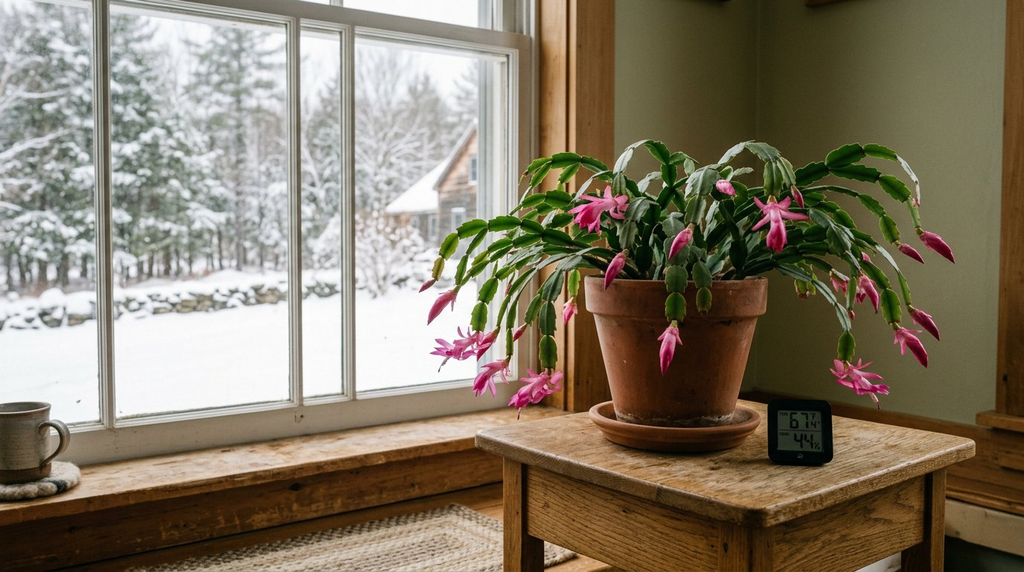
A Christmas cactus releases a little moisture into the air, but I wouldn’t count on one plant to raise the humidity of a room. If your cactus looks wrinkled or is dropping buds, check the air with a humidity meter and the potting mix with your finger. Dry air and dry roots aren’t the same problem.
Does Christmas cactus improve indoor humidity enough to notice?
Not enough to rely on. A Christmas cactus gives off water vapor through its green stems, a process called transpiration. Water also evaporates from the potting mix. Some of that moisture reaches the air right around the plant, but it mixes with the rest of the room. How much difference you could measure depends on the size of the plant and room, the temperature, and how quickly the air is replaced.
I don’t know of a dependable measurement that tells you how much one Christmas cactus will raise the humidity in an ordinary heated room. I wouldn’t turn a reading taken right above a freshly watered pot into a claim about the whole house. If you want to know whether the room is dry, measure the room. If you want to know whether the plant is sitting in a bad spot, measure where it grows.
That distinction matters on a Vermont winter morning. The air by cold window glass can be cooler than the air over a heating register, even when the two spots are only a few feet apart. Relative humidity changes with temperature, so the reading by the window doesn’t necessarily tell you what the plant gets when the furnace comes on.
How I’d check the air around the plant
- Set a humidity meter near the plant at about stem height. Keep it out of direct sun and away from damp soil, cold glass, and the direct path of a heating vent. Give it time to settle before noting the reading.
- Check at two times of day for a few days. A first-thing-in-the-morning reading and another while the heat is running can tell you more than one number. Note the temperature too, if your meter shows it.
- Use the same meter elsewhere in the room. Let it settle again. If the plant’s spot is consistently warmer and drier than the rest of the room, I’d deal with the hot airflow before trying to humidify the whole space.
If the plant is firm and growing or flowering normally, I don’t chase a perfect reading. If the air is persistently dry and you want to raise humidity for the room itself, a clean humidifier gives you more control than a plant or a tray of water. Follow its cleaning instructions and dial it back if you start seeing condensation on the windows. I wouldn’t trade dry air at the plant stand for damp window frames.
Wrinkled stems: check the pot before you blame the air
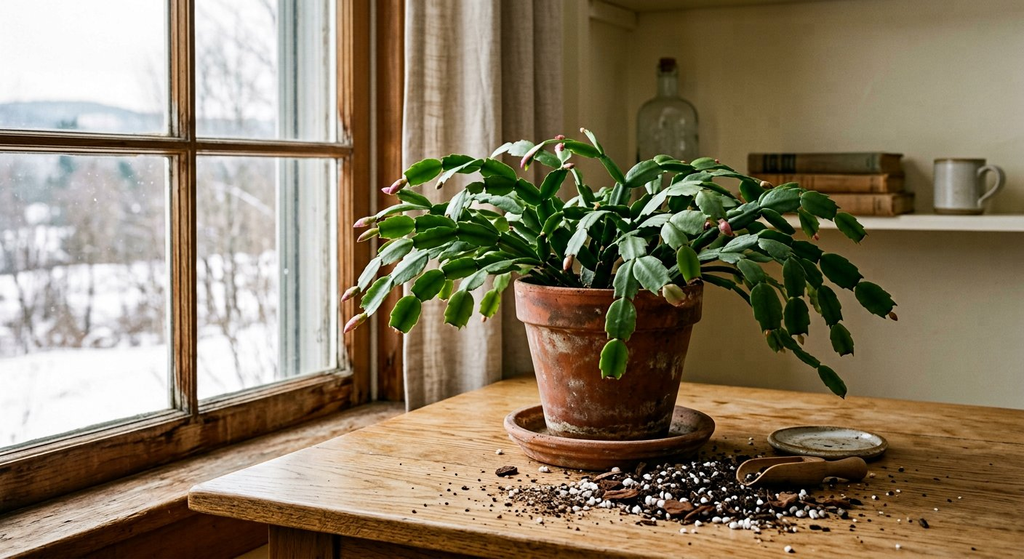
Wrinkling is something you can see. It doesn’t tell you why the plant has lost firmness. A dry root ball can leave the stems short of water. Roots that have been sitting in wet mix can also stop taking up water, and the stems can look just as thirsty. Those two pots need opposite treatment.
I like to lift the pot before reaching for the watering can. A light pot with dry mix below the surface tells me more than a wrinkle does. A heavy pot with a dry-looking top makes me pause. The surface can dry while the lower part of the pot stays wet, especially in a cool room or inside a decorative outer pot.
| What you see | What might explain it | What to check next | What I’d change first |
|---|---|---|---|
| Wrinkled segments and a light pot | The root ball may be too dry | Feel about ½–1 inch (1–2.5 cm) down, as pot depth allows; see whether the mix has pulled from the sides | If it’s dry below the surface, water slowly and let the excess drain |
| Wrinkled segments and a heavy pot | Wet mix may be limiting air around the roots; rot is possible | Look for trapped water, a sour smell, or soft roots if the mix stays wet | Empty the outer pot and pause watering; inspect the roots promptly if the base is soft |
| Buds shrivel or fall | A move, temperature swing, or uneven watering may have stressed the plant | Think back to a recent move, a cold night, a hot vent, or a pot that swung from dry to soaked | Keep the spot stable and correct the specific problem you find |
| Dry, pale patch on the window side | Direct sun may have scorched the stem | Watch where a beam of sun falls during the day | Filter the harsh light with a sheer curtain |
| Firm green segments but no flowers | Nights may have been too bright or warm, or you may have a different holiday cactus | Check night lighting, temperature, and segment shape | Plan a stretch of cool, uninterrupted nights during the next bud-setting season |
| Soft, dark tissue spreading from the base | Stem or root rot is possible | Check whether the base and roots are firm or soft and collapsing | Act now rather than waiting for the pot to dry on its own |
One older segment with a crease doesn’t worry me as much as several stems getting limp at once. I look at the newest growth and the base of the plant, then check the pot. That gives me a better starting point than trying to diagnose a problem from a single close-up.
Give the roots air without drying the plant out
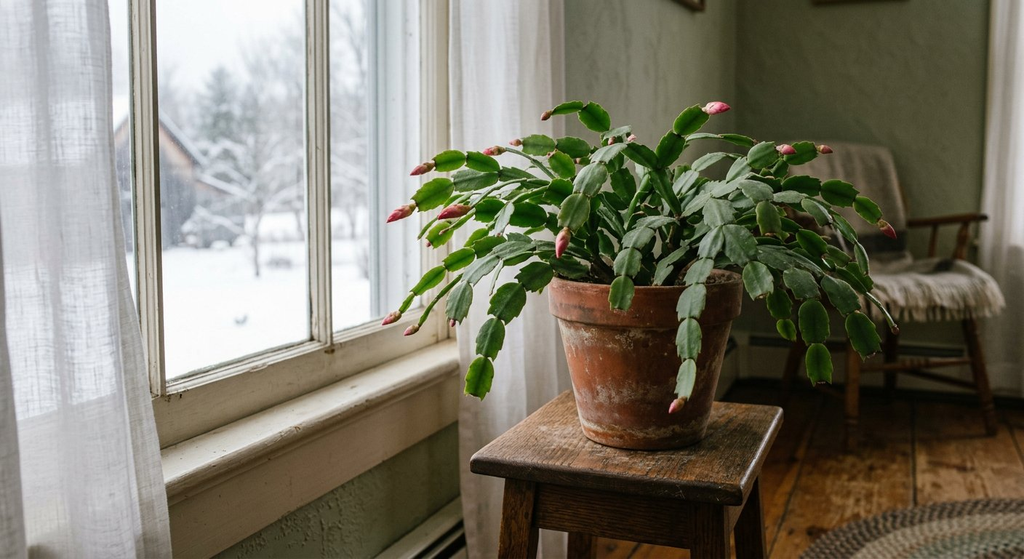
Christmas cactus comes from a group of forest cacti native to Brazil’s coastal region. These plants often grow as epiphytes, perched on trees rather than rooted in deep soil. Their roots can get wet, but they also get air. The Royal Horticultural Society’s Schlumbergera growing notes recommend bright light out of direct sun and a well-drained mix. 2
At home, I’d use a loose potting mix with perlite and, if the mix needs more structure, a little fine bark. The point isn’t to follow a recipe by the cup. It’s to avoid a dense root ball that stays wet long after the surface dries. I want a pot with drainage holes and a saucer I can empty without having to tip the plant sideways.
A slightly snug pot suits this cactus. If the plant is healthy and its mix still takes up and drains water evenly, I don’t repot just because I can see a root. When it does need more room, I go up one pot size rather than surrounding a small root ball with a large volume of wet mix. If I’m repotting after root loss, I size the pot to the roots that remain.
When the mix is ready for water, I water it thoroughly and let it drain. If very dry mix sheds water down the sides, I make a slow second pass rather than assuming a wet saucer means the center got wet. During bloom I try to avoid big swings from dry to soaked. After flowering, when growth slows, I usually water less often. That rest is a reason to check the pot less urgently, not a reason to let the root ball stay bone dry for weeks.
Common mistakes I watch for
- Watering for the furnace instead of the pot. The room can feel dry while the roots are still wet. I let the weight of the pot and the feel of the mix guide the next watering.
- Treating a quick mist as a humidity fix. Water beads on the stems for a while, but that doesn’t tell you the room stayed more humid. I’d rather move the plant out of hot airflow than keep spraying it.
- Letting a pebble tray become a bath. A tray can evaporate some water, but I wouldn’t expect it to fix room humidity. If you use one, keep the pot above the water. It should still be able to drain freely.
- Changing everything after the first fallen bud. If the pot drains and there’s no sign of rot, I start with the most obvious change, such as a vent suddenly blowing on the plant. Moving it from window to window makes it harder to tell what helped.
Winter buds need steady conditions more than a humidity boost
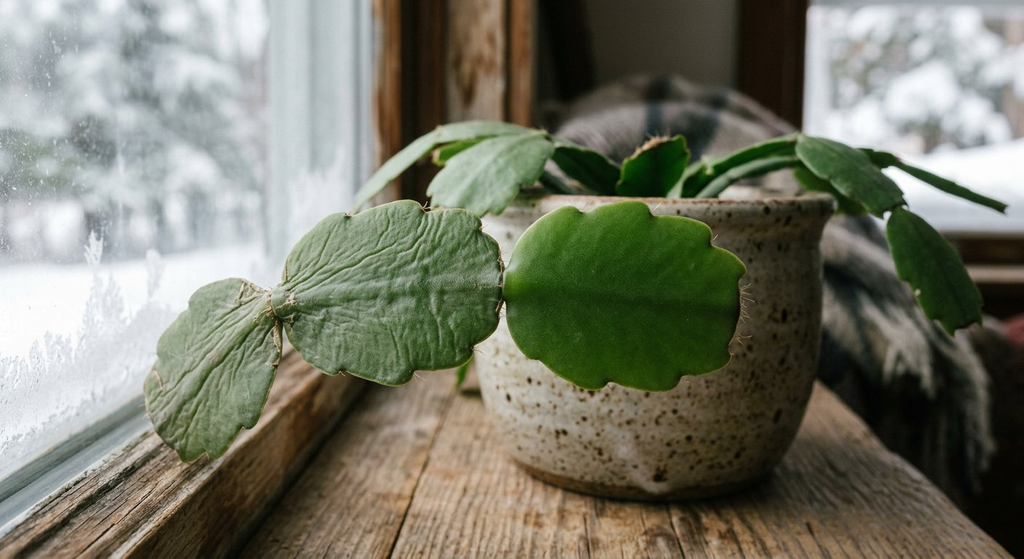
A bud that looked plump yesterday and looks pinched today gets my attention. It still isn’t a humidity reading. If that happens, I look at what changed: whether a hanging stem now touches the cold glass, whether the pot went dry during bloom, or whether the plant came from a cooler spot into a warm room. Sudden changes in light, temperature, or position can contribute to bud drop.
For a plant that hasn’t set buds, I start with its nights. The University of Minnesota Extension’s Holiday cacti guide explains how short days and cool nights work together. Around 55°F (13°C), cool conditions can help trigger flowering even when day length varies. At 60–65°F (16–18°C), the guide calls for at least 12 hours of complete darkness each night for about six weeks. 1
My starting point would be 12–14 hours of uninterrupted darkness nightly for about six weeks, with bright, indirect light in the daytime and nights around 55–60°F (13–16°C) if there’s a spot that stays that steady. A cool room is different from a freezing draft. Once buds are visible, I favor a stable spot over moving the pot every evening. None of this guarantees flowers by a particular holiday.
The label may also be part of the puzzle. Thanksgiving cactus (Schlumbergera truncata) generally has pointed teeth along its stem segments. The classic Christmas cactus (Schlumbergera × buckleyi, sometimes sold under the older name S. bridgesii) has rounder scallops. Easter cactus is a different holiday cactus and usually blooms in spring. I use the segments as a clue rather than relying on the name on the tag or the week the flowers open.
Give recovery time, but don’t wait on soft tissue
If the pot was genuinely dry, I’d look for some return of firmness over the next several days after a thorough watering. Old creases may not disappear. I wouldn’t water a second time just to make them go away. What I want to see is that the limpness stops spreading and the mix starts to dry at a normal pace.
If the pot was too wet but the base and roots are firm, empty any trapped water and let the mix begin drying. If the mix stays wet, smells sour, or the plant keeps declining, slide the root ball out gently. With compromised roots, I look for deterioration to stop before I expect any new growth. That can take weeks. A bud that has already dropped won’t reattach, and a recovering plant may miss this flowering cycle.
If the base is soft and dark or the roots are breaking apart, I wouldn’t wait a week to see what happens. If there are still firm, clean sections well above the damaged area, a cutting of two or three healthy segments may give you a way to keep the plant going. Use a clean tool, let the cut end dry briefly, then root it in a small pot of lightly moist, airy mix. If softness has reached every stem and there’s no firm tissue left, I’d let the plant go rather than promise a rescue.
If you can’t tell whether you’re seeing rot, cold injury, or something else, photos of the whole plant, the base, and the roots are more useful than a close-up of one wrinkle. A local cooperative extension office can help you sort through those signs, especially if the plant is declining despite a change in care.
Tomorrow morning, lift the pot before you water. Whether it feels unexpectedly heavy or light will tell you more about your next move than the word “humidity” on a care tag. If that check turns up another care question, you’ll find more growing notes on the Christmas Cactus Cares homepage.
Frequently asked questions
Can one Christmas cactus humidify a bedroom?
A Christmas cactus releases water vapor, but I wouldn’t rely on one plant to raise bedroom humidity by a useful amount. Use a humidity meter where you want to know the reading, not right above the pot.
Should I mist my Christmas cactus in winter?
I don’t use misting to manage winter humidity. It wets the stems briefly without reliably raising room humidity. If a heating vent is blowing directly on the plant, I’d deal with the airflow first.
Do wrinkled Christmas cactus stems mean the air is too dry?
Not necessarily. Both dry mix and damaged roots in wet mix can leave stems wrinkled. Lift the pot and feel below the surface before deciding whether to water.
Can I save a Christmas cactus after the buds fall?
Often, yes. Fallen buds won’t return, but bud drop alone doesn’t mean the plant is dying. If the stems and base are firm, keep the conditions steady and check the mix before watering. A soft, dark base calls for a closer look at the roots.
About the author
Aiden Hall is a Vermont home grower who has cultivated Schlumbergera indoors for 10 years. He writes Christmas Cactus Cares from direct experience with plants in his own home. He’s a dedicated home grower, not a botanist, professional grower, or certified master gardener. You can send Aiden a question about your holiday cactus.
Leave a Reply