My name is Aiden Hall, and I have spent over a decade growing Schlumbergera plants inside my home here in Vermont. Living in New England means dealing with drastic seasonal changes. Our summers bring thick, heavy air, while our long winters turn indoor spaces bone-dry due to heating systems.
Over the years, I have learned that managing humidity is just as important as managing water or light. Many plant growers assume all cacti prefer desert dryness. However, holiday cacti are tropical epiphytes native to the coastal rainforests of southeastern Brazil.
In this guide, I will share practical steps on maintaining optimal humidity levels for your Christmas cactus. We will cover natural habitats, ideal target ranges, seasonal tweaks, and simple setups to keep your plants thriving year-round.
Rainforest Roots: Understanding Natural Schlumbergera Habitats
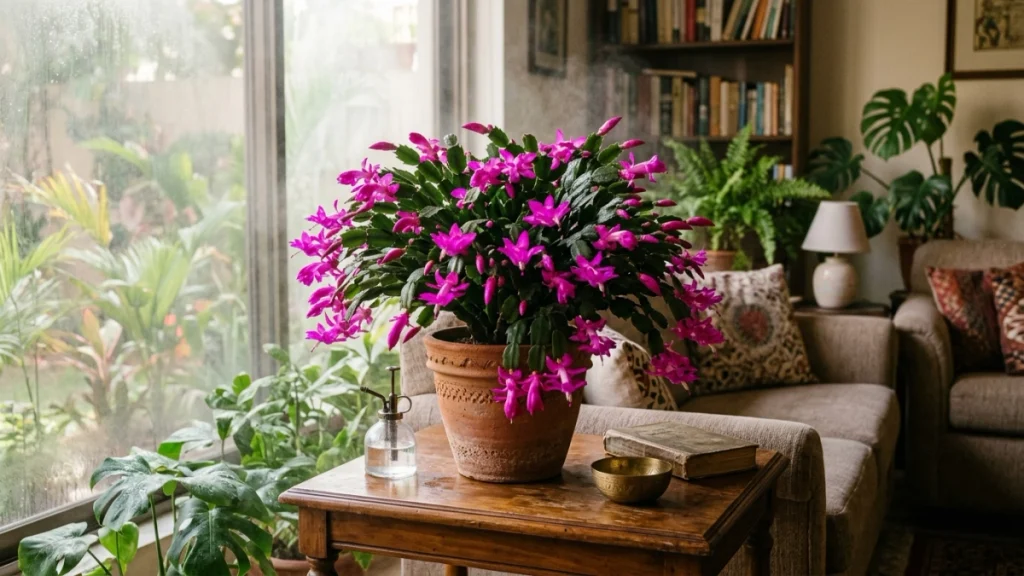
To understand what your plant needs at home, it helps to look at where it grows in the wild.
       NATURAL CANOPY ENVIRONMENT               INDOOR HOME ENVIRONMENT
+---------------------------------------+  +---------------------------------------+
|  Location: Serra do Mar, Brazil       |  |  Target Humidity: 50% - 60%           |
|  Elevation: 2,000 - 4,500 feet        |  |  Winter Indoor Air: 15% - 25% (Low!)  |
|  Ambient Humidity: 70% - 80%          |  |  Challenge: Prevents Bud Drop & Wilting|
|  Substrate: Moss, Bark, Leaf Litter   |  |  Solution: Pebble Trays & Humidifiers |
+---------------------------------------+  +---------------------------------------+
Christmas cacti (Schlumbergera) originate in the high-elevation coastal mountains of the Organ Mountains (Serra dos Órgãos) in southeastern Brazil. They do not grow in hot, sandy desert floors. Instead, they live attached to tree branches or rocky crevices high up in the forest canopy.
In these cloud forests, moisture levels remain consistently high. Ambient air humidity rarely drops below 70%, often hovering between 70% and 80% year-round. High humidity keeps the plant hydrated even though its roots sit in small pockets of organic debris.
Understanding these epiphytic roots reveals why dry household air causes quick stress. When air moisture drops, your cactus loses water rapidly through its flattened stem segments (cladodes).
Ideal Indoor Humidity Targets: The 50% to 60% Sweet Spot
Inside a typical residence, indoor humidity fluctuates significantly across seasons.
| Season | Typical Home Relative Humidity (RH) | Target Ideal RH Range | Primary Plant Concern | Recommended Action |
| Spring | 40% – 50% | 50% – 60% | Active new segment growth | Keep away from cold window drafts |
| Summer | 50% – 70% | 50% – 60% | Heat stress & fungal spots | Ensure strong room air circulation |
| Autumn | 35% – 45% | 50% – 60% | Bud initiation & stability | Add pebble tray; maintain steady moisture |
| Winter | 15% – 30% | 50% – 60% | Bud drop & stem shriveling | Run cool-mist humidifier nearby |
For healthy growth and vibrant blooms, aim for an indoor relative humidity range of 50% to 60%.
Your Christmas cactus can tolerate temporary drops down to 30% or 40%. However, extended exposure to dry air causes the plant to draw moisture from its stem tissues. This leads to thinned segments, wilted growth, and fallen flower buds.
To track air moisture accurately, place a small digital hygrometer right near your plant collection.
Timing Your Humidity for Blooms: Fall to Winter Care
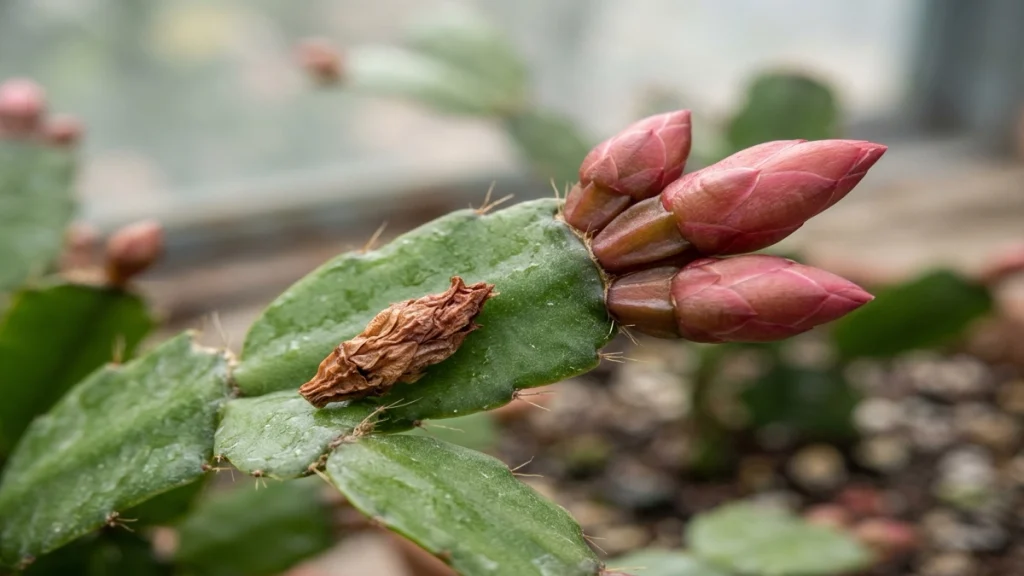
Adjusting atmospheric humidity is critical during the pre-bloom and flowering stages in autumn and winter.
Pre-Bloom Phase (Late September to October)
In early autumn, your plant requires two distinct triggers to form flower buds: cool night temperatures (55°F to 65°F) and long night hours (12 to 14 hours of continuous darkness).
During this setup phase, keep humidity strictly between 50% and 60%. Dry indoor conditions during early bud setup force the plant to shed tiny emerging buds before they mature.
Active Blooming Phase (November to January)
Once flower buds enlarge, stability becomes essential. Rapid changes in relative humidity, temperature swings, or dry air from heating vents trigger premature flower drop (bud drop).
- Keep your plant far away from forced-air heat vents and fireplaces.
- Avoid moving the container to new locations once buds show strong color.
- Maintain ambient room humidity above 50% using continuous ambient methods.
Not All Zygocacti Are Created Equal: Species Variations
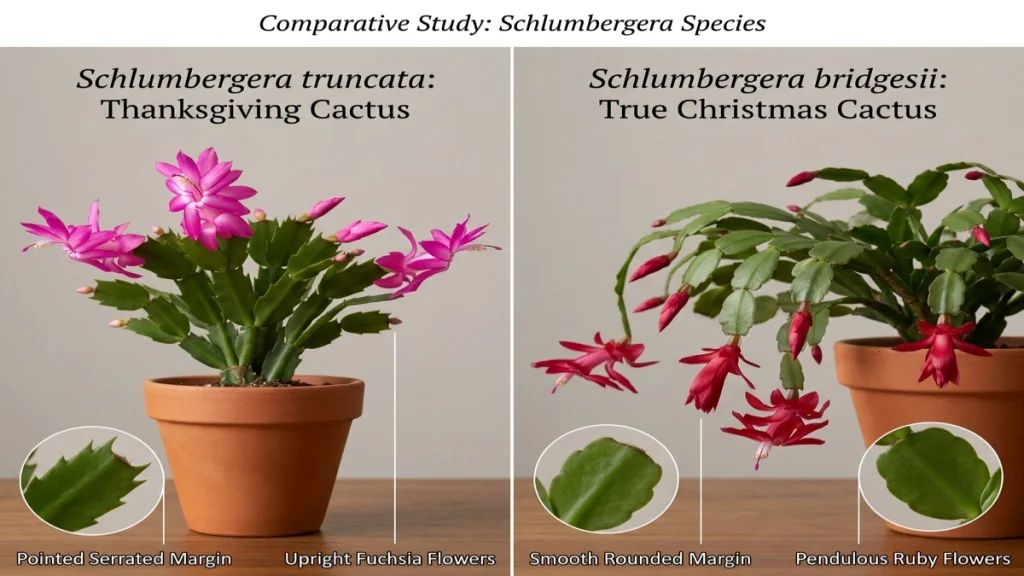
Many growers use the term “Christmas cactus” for several distinct holiday species. While their moisture needs are similar, identifying your exact plant helps tailor overall care.
SCHLUMBERGERA TRUNCATA (Thanksgiving Cactus)
Stem Cladode: Pointed, claw-like serrated teeth along edges.
Anthers: Yellow pollen.
Bloom Time: Late autumn (November).

SCHLUMBERGERA BRIDGESII (True Christmas Cactus)
Stem Cladode: Smooth, rounded scalloped margins.
Anthers: Purplish-brown pollen.
Bloom Time: Early to mid-winter (December/January).
- Thanksgiving Cactus (Schlumbergera truncata): Features sharp, claw-like projections along its segment edges. It blooms earlier and tends to tolerate lower room humidity slightly better.
- True Christmas Cactus (Schlumbergera bridgesii): Features soft, rounded segment margins and pendulous flowers. It naturally prefers higher, stable moisture levels (around 55% to 65%).
- Easter Cactus (Rhipsalidopsis gaertneri): Features rounded stem margins with tiny bristles at the tips. It sets buds in late winter and requires strict, elevated spring humidity to open flower buds successfully.
Humidity and Your Potting Mix: Balancing Air and Water
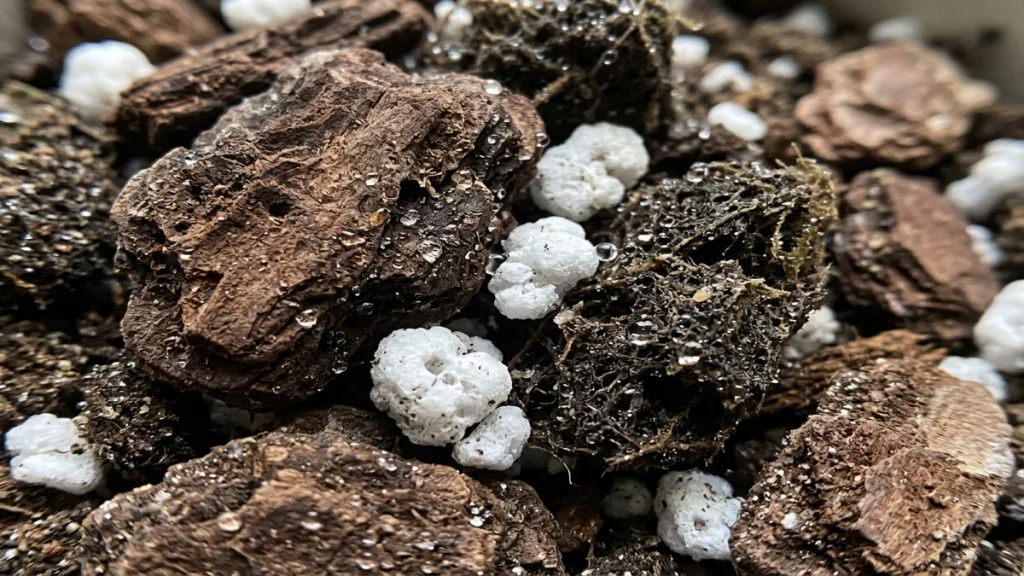
Atmospheric humidity works hand-in-hand with root zone moisture. Because epiphytes grow attached to trees in nature, their roots need oxygen just as much as water.
If you raise atmospheric humidity around a plant sitting in heavy, dense potting soil, you risk root rot. High ambient humidity slows down water evaporation from the soil surface.
Building the Right Medium
To keep roots healthy while maintaining high air humidity, use a porous, well-draining mixture:
- 1 Part Quality Organic Potted Soil Mix
- 1 Part Coarse Perlite or Pumice
- 1 Part Coarse Orchid Bark Bits
This chunky composition lets excess water drain away instantly while retaining tiny air pockets around root structures.
Always select pots with built-in drainage holes. Terracotta pots allow moisture to evaporate through their porous clay walls, which is great for damp climates. Plastic or glazed ceramic pots hold soil moisture longer, making them ideal for dry home interiors.
Practical Methods to Raise Indoor Humidity
If your home air tests below 40% RH, try these practical setups to raise local humidity safely.
       HUMIDITY TRAY DIAGRAM (PEBBLE TRAY)

  +-----------------------------------------+
  |  [ Schlumbergera Container ]           |
  |  [ Pot Drain Holes Sit Above Water ]   |
  +-----------------------------------------+
       | |                           | |
  ===========================================  <-- Dry Tray Rim
  |  o   o   o   PEBBLES   o   o   o    o |
  |~~~~~~~~~~ WATER LEVEL ~~~~~~~~~~~~~~~~~~|  <-- Water Below Top of Pebbles
  +-----------------------------------------+
1. The Humidity Tray Method (Pebble Tray)
A pebble tray offers a simple, low-cost way to raise local moisture around foliage without electrical power.
- Select a shallow tray or saucer at least two inches wider than your plant’s rim.
- Fill the tray with clean pebbles, river stones, or expanded clay pebbles.
- Pour water into the tray, keeping the water level just below the tops of the pebbles.
- Set your potted cactus directly onto the stones.
As water evaporates from the tray, it creates a gentle zone of humid air around the leaves. Ensure the bottom of the pot never sits in standing water to prevent root rot.
2. Room Humidifiers
For cold winter climates, running a digital cool-mist ultrasonic humidifier is the most reliable method. Position the unit 4 to 6 feet away from the plant so damp mist does not settle directly onto leaf segments.
3. Grouping Plants
Grouping tropical houseplants creates a shared microclimate. As plants release moisture through transpiration, they raise relative humidity for neighboring pots. Place your Christmas cactus alongside ferns, calatheas, or peace lilies.
4. Why Misting Is Not Recommended
Many plant guides suggest spraying water directly onto leaves with a mister bottle. However, misting provides poor long-term results:
- It raises local humidity for only 5 to 10 minutes.
- Standing water droplets on leaf segments encourage fungal pathogens like Fusarium and Bipolaris rot.
- Misting blooming plants can spot or stain delicate flower petals.
Troubleshooting Humidity-Related Symptoms
Use this visual guide to identify and fix common moisture problems.
+-----------------------------------------------------------------------+
|                       TROUBLESHOOTING MATRIX                          |
+-----------------------------------------------------------------------+
|  SYMPTOM                      | LIKELY CAUSE      | CORRECTION        |
|-------------------------------+-------------------+-------------------|
|  Thinned, puckered segments   | Low air humidity  | Add pebble tray;  |
|  despite damp soil            | or root damage    | check root system |
|-------------------------------+-------------------+-------------------|
|  Flower buds drop off         | Low winter RH or  | Raise RH to 50%+; |
|  before opening               | drafty heat vent  | move away from air|
|-------------------------------+-------------------+-------------------|
|  Blackened, soft stem bases   | High humidity +   | Reduce soil water;|
|  with sour soil odor          | soggy soil roots  | repot in bark mix |
+-----------------------------------------------------------------------+
Low Humidity Signs
- Segment Wrinkling: Stem cladodes lose their firm, fleshy texture and look wrinkled or leathery.
- Bud Abscission: Tiny flower buds stop growing, turn reddish-brown, and fall off easily.
- Stem Droop: Entire branches drop low and lose structural stiffness.
Excessive Humidity Signs (with poor airflow)
- Fungal Leaf Spot: Dark brown or black water-soaked spots appear on stem segments.
- Gray Mold (Botrytis): Fuzzy gray mold develops on flower buds or opening petals.
- Stem Rot: The base of the stem near the soil line turns mushy and translucent.
If high humidity causes fungal spots, improve room airflow with a small ceiling or floor fan set to low speed. Keep the fan pointed away from the plant.
Seasonal Care Schedule
Follow this seasonal checklist to manage humidity levels throughout the year:
- Spring (Active Growth):
- Target Humidity: 50% – 60%.
- Water when the top inch of soil feels dry.
- Resume light feeding with balanced plant food.
- Summer (Outdoors or Indoor Window):
- Target Humidity: 50% – 70%.
- Protect plants from harsh, direct afternoon sun.
- Maintain steady air movement to prevent fungal growth during humid spells.
- Autumn (Bud Setup Phase):
- Target Humidity: 50% – 60%.
- Expose plants to 12-14 hours of continuous night darkness.
- Set up pebble trays before indoor heating systems turn on.
- Winter (Full Bloom & Rest):
- Target Humidity: 50% – 60%.
- Keep ambient room temperatures between 60°F and 70°F.
- Run a cool-mist humidifier to offset dry heating systems.
Frequently Asked Questions
What is the ideal humidity level for a Christmas cactus?
The ideal humidity level is between 50% and 60%. While plants can survive temporary drops down to 30%, consistent low humidity leads to stem shriveling and bud drop during flowering seasons.
Does misting increase humidity for a Christmas cactus?
Misting increases air moisture for only a few minutes. Additionally, leaving standing water droplets on leaves can trigger fungal leaf spots. Using a pebble tray or cool-mist humidifier provides safer, more consistent moisture.
Why are my Christmas cactus leaves limp despite regular watering?
Limp leaves often occur when dry ambient air causes the plant to lose moisture faster than its roots can take it up. It can also indicate damaged roots from overwatering. Check that your potting mix is loose and drainage holes remain clear.
About the Author
Aiden Hall is an indoor horticulture author and home grower based in Vermont. With over a decade of hands-on experience cultivating Schlumbergera and other tropical epiphytes, Aiden specializes in indoor humidity management, soil aeration, and seasonal bloom setup. His care guides focus on practical techniques to help home gardeners grow healthy, long-lasting house plants.
For more detailed guides on potting mixes, lighting, and seasonal care, visit our home resource page at Christmas Cactus Cares.
Leave a Reply