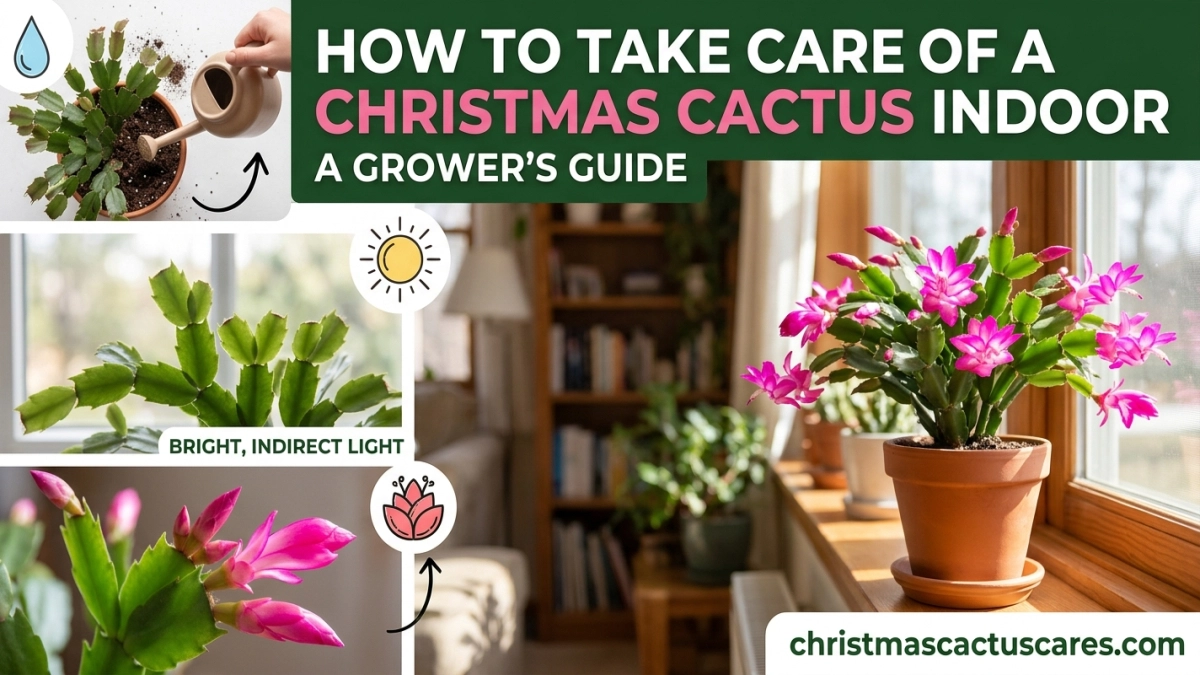
To take care of a Christmas cactus indoor, you must provide bright, indirect light, avoid overwatering by letting the top inch (2.5 cm) of soil dry completely, and keep temperatures moderate (60–75°F / 15–24°C). The biggest mistake is treating it like a desert cactus; it needs consistent humidity and thorough, infrequent watering in well-draining soil.
That is the short answer. If your plant is struggling right now, that single paragraph might be enough to save it. But I imagine you are here because you want more than a quick fix. You want to understand this unique plant that, in my house, seems determined to contradict its own name.
Hello, I’m Aiden Hall. I have been growing houseplants in Vermont for over ten years, and for almost that entire time, I’ve had at least one Schlumbergera (the official name for this group of plants) keeping me company. Let me be clear right away: I am not a botanist. I don’t have a degree in horticulture, and I am not a certified master gardener. I am just a home grower, much like you, who learned how do you take care of a christmas cactus indoor mostly by trial, error, and observing the plants on my own windowsills.
My goal here is to share the simple, practical routine I use every day. If you are reading this, your plant is likely suffering, or you are worried you might kill it. I want to help ease that worry. This isn’t professional advice; it’s the honest, lived experience of a neighbor down the road who genuinely loves these plants.
First, Forget Everything You Know About “Cactus” Care
The common name is the first problem. When most of us hear “cactus,” we think of hot, dry deserts, blazing sun, and barely any water. The Christmas cactus is nothing like that.
These plants are epiphytes—botanical language meaning they grow on other plants, usually nestled in the forks of trees in the coastal rainforests of Brazil. They do not grow in soil. They grow in rotting leaves and organic debris, soaking up the frequent, heavy rain and then drying out quickly thanks to excellent air circulation.
This changes everything about how I care for them. In my Vermont living room, I have to replicate that humid, airy, well-draining forest floor as best I can.
Light and Temperature: The Comfort Zone
When people ask me how do you take care of a christmas cactus indoor, light is always my second answer (after water). In their native habitat, they live under a dense canopy. They love light, but they cannot handle direct, scorching sunlight.
My rule is simple: bright, indirect light is gold. Directly in a south-facing window in Vermont will bleach the segments and stress the plant, turning it a reddish-purple color that looks sickly, not festive. In my house, I place them:
- Right next to an east-facing window.
- A few feet back from a west-facing window.
- Directly in a north-facing window during our long, dim winters (this is often the only way they get enough light then).
They prefer moderate temperatures. The same range humans like: 60–75°F (15–24°C). They tolerate slightly cooler nights, which is actually the key to getting them to bloom (more on that later). But consistent heat from a radiator or a freezing draft from an old window pane will cause them stress.
Watering: The Right Kind of “Thirsty”
Watering is the hardest part. It’s where I made the most mistakes in my first three years.
You must not treat this plant like a desert succulent. It needs water, and it needs it regularly when it is growing. But its roots are delicate and designed for air. If they sit in soggy, standard potting mix, they will die from root rot faster than any other plant I own. I separate watering into two phases: observing and acting.
How I observe: Before I even look for my watering can, I touch the soil. I poke my finger down an inch (2.5 cm). Is it damp? I do not water. Is it bone-dry all the way down? It’s probably too dry. I also check the plant segments; if they look dull and thin, the plant is telling me it needs water.
How I act: My routine is “soak and dry.” I move my plant to the sink. I water it thoroughly until water streams out of the drainage holes. I let it sit for 15 minutes to finish dripping. Then, I put it back in its saucer, which is always empty. I never, ever let the pot sit in standing water.
During the active growth seasons (spring and summer), I do this roughly once a week. In winter, after the blooming is done and the plant goes into dormancy, I reduce watering significantly—maybe once every 2–3 weeks, checking the soil each time.
Soil and Potting: It Needs to Breathe
The best way to take care of a Christmas cactus indoor is to give it soil that mimics its home. I never use standard indoor potting mix straight out of the bag; it holds too much water.
My mix is simple:
- 2 parts regular potting soil.
- 1 part coarse sand or (better) chicken grit.
- 1 part coarse perlite.
That perlite is non-negotiable. Those white, puffy bits create air pockets, which is exactly what epiphytes need. When you water, the mix should be loose and airy, and water should immediately run through.
I have learned that these plants prefer being slightly root-bound. I keep them in a pot that looks just a little too small. When I must repot, I only go up one pot size. They are perfectly happy in the same pot for 3–5 years.
The Blooming Mystery: Getting it Right
This is the number one problem my readers have. “My plant looks fine, but why doesn’t it bloom?” It’s not a mystery; it’s botany. They need specific environmental triggers to initiate buds.
To get your Christmas cactus to bloom, you must provide:
- Cool Temperatures: They need night temperatures between 50–60°F (10–15°C) for six weeks. This is usually our fall in Vermont, so I often let mine stay near a slightly cooler window in a rarely-used guest room.
- Short Days/Long Nights: This is critical. They need 12–14 hours of total, uninterrupted darkness every single night for those same six weeks. Even turning on the room light for ten minutes at night can “reset” the clock and stop bud formation.
This is why “my plant blooms in January!” is such a common complaint. If it lives in a living room with evening lights, it won’t bloom until the days naturally get short enough, which in Vermont is January, not Christmas. To force it for a true December bloom, you can create a “dark box” routine starting in October.
Troubleshooting: Map Your Symptoms
When your plant looks sad, the first thing I do is stop and observe. “Wrinkled” is not a diagnosis. A wrinkled segment is just an observation. We need to map it to a likely cause and a real check.
| Symptom (Observation) | Likely Cause | What to Check (Observation) | What to Change (Action) |
| Dull, wrinkled, limping segments | Overwatering | Is the soil wet 1″ down? Does the pot smell musty? | Stop watering immediately. Check drainage. If soil is sodden, repot. |
| Dull, wrinkled, thin segments | Underwatering | Is the soil bone-dry all the way down? Are the roots pullable? | Soak thoroughly. Check more frequently. |
| Bud Drop (buds form, then fall) | Sudden Change | Has the plant been moved? Is there a new draft? | Return to previous, stable spot. Avoid drafts. Do not move when buds are set. |
| Red/Purple segments | Light Stress | Is it sitting in direct, direct sun? | Move to indirect light. (Some people do this on purpose, but I find it stresses the plant). |
| Yellow segments | Nutrient deficiency / Rot | Is the soil wet? Have you fertilized? | (Most common) If wet, treat for rot. If soil is old, apply balanced fertilizer (1/2 strength) only in spring/summer. |
| No Flowers | Light/Temp signals missing | Has it had 6 weeks of 50-60°F nights? 14 hours total dark? | Provide cooler nights and total nighttime darkness for 6 weeks starting in Oct. |
When is it Already Too Late?
This is the hardest question to ask, and the hardest one for me to answer. Sometimes, you just can’t take care of a Christmas cactus indoor once a certain line has been crossed.
If you suspect root rot (the soil smells like rotting garbage and the base of the stems is black and soft), there is almost zero chance of recovery. That is not a failure on your part; it is just a plant that is already too far gone.
The only remaining hope is to take a healthy stem cutting above the rot and propagate it. If the whole plant is soft, it is time to part with it honestly. A healthy plant will have segments that feel firm and “meaty,” not soft or limp. You can see this visual contrast on the author page where I show one of my successful propagation trials.
Common Mistakes I Have Made (So You Don’t Have To)
- Treating it Like a Desk Accessory: I used to keep mine on a beautiful desk, far from any window. It didn’t die, but it never grew and never bloomed. I learned the hard way that they need that window light.
- Moving it During Bud Set: The quickest way to get bud drop (or “bud blast”) is to get excited, move the pot to a better-display table, and have all your flowers fall off the next day. Once buds are set, I never, ever move the pot.
- Applying Professional Rules to a Home Plant: You might read that commercial growers use specific N-P-K ratios on a precise schedule. That is their job. My job is to make a plant happy in my house. I rarely fertilize mine, maybe once or twice in the summer with very weak fish emulsion. I’ve found that consistency in light and water is ten times more important than fancy nutrients.
Looking Ahead: One Simple Goal
We’ve covered soil, light, temperature, water, and blooming, and we’ve even talked about failure. That is a lot of information. My advice to you, right now, is this: forget all the specific metrics and dates.
Do not write down a schedule. Your plant doesn’t read calendars. Instead, I want you to make a commitment to one single action tomorrow morning:
Go to your plant and poke your finger into the soil.
That’s it. Is it damp? Do nothing. Is it dry? Soak it. If you build that simple observational habit, you will automatically start to understand what your specific Christmas cactus in your specific window needs. Taking care of a Christmas cactus indoor is not a science; it is a conversation, and the best way to have it is to start by checking the soil.
If you still have questions or are worried about your specific situation, please feel free to contact us. I may not have a master gardener certification, but I do have ten years of Vermont observations, and I am happy to share them.
ABOUT THE AUTHOR
Aiden Hall is a home grower in Vermont who has been cultivating Schlumbergera indoors for over 10 years. He writes practical, experience-based guides on indoor plant care, sharing the simple routines that keep his houseplants thriving in a northern climate. Aiden is explicitly a dedicated home grower rather than a botanist or certified professional. You can read more about his growing philosophy on the author page, or ask him a plant question via contact us.
Leave a Reply