
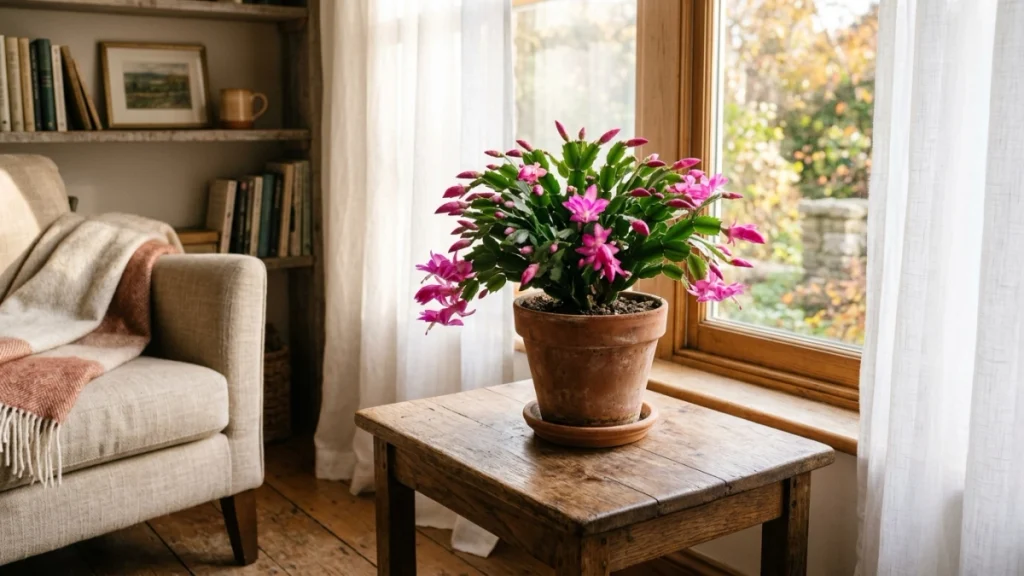
To keep a Christmas cactus healthy and budding, place it within 2 to 3 feet (60 to 90 cm) of an east-facing window where it receives bright, indirect light without direct midday sun. If an east window is unavailable, an unshaded north window or a set-back south or west window filtered by sheer curtains works equally well. Keep the plant in a spot that stays between 65°F and 75°F (18°C to 24°C) during the growing season, clear of drafts, hot radiator vents, and glass panes that chill below 50°F (10°C).
Finding the right spot for this plant in a normal home often causes unnecessary stress. When I brought home my first Schlumbergera a decade ago, I put it on a high bookshelf far from any window because I assumed cacti preferred dry room corners. Within three weeks, the dark green stem segments softened and turned a dull gray-green. Later, I moved it right up against a south-facing glass window in July, only to watch the flattened segments turn reddish-purple from sun scorch.
The confusion usually stems from the word “cactus.” True Christmas cacti are tropical epiphytes native to the cool, humid coastal rainforests of southeastern Brazil. In their natural habitat, they grow on tree branches under a dense jungle canopy rather than in desert sand. They require bright filtered sunlight, steady airflow, moderate humidity, and protected roots. Understanding this native background makes choosing a location in your living space straightforward. If you ever want to read more about my personal journey growing these plants in my northern home, check out my story on my about page.
How Light Exposure Dictates Placement Across Your Windows
Light exposure is the single most important factor when choosing where to place your plant indoors. The goal is maximum ambient brightness without direct ultraviolet rays cooking the leaf-like stem segments, botanically known as phylloclades.
Here is how different window exposures in a typical home perform for a Christmas cactus:
- East-Facing Windows (Ideal Choice): An east window delivers gentle early morning sun when light intensity is low and ambient room temperatures are cool. Sunlight hits the plant directly for two to three hours at an gentle angle, providing ideal energy for photosynthesis without scorching tissue.
- North-Facing Windows (Reliable Secondary): North windows supply smooth, even indirect light throughout the day. In northern climates with long winter nights, a north window keeps the foliage lush green. If you notice the branches reaching out and growing thin or spindly, move the pot 12 inches (30 cm) closer to the glass.
- West-Facing Windows (Requires Caution): West light carries strong afternoon heat. During late spring and summer, intense west sun can quickly bleach or burn stem segments. Place the pot 4 to 6 feet (1.2 to 1.8 meters) back from a west window, or hang a sheer white curtain to soften the rays.
- South-Facing Windows (Requires Filtering): South-facing glass offers the highest light volume. In depth of winter, a south window provides welcome light. However, from April through October, direct south light will scorch the foliage. Always diffuse south light with sheer blinds or move the plant well into the room interior.
To verify your lighting levels without buying expensive equipment, try the simple hand-shadow test. Hold your hand 12 inches (30 cm) above the plant’s surface during peak midday sun. If your hand casts a sharp, dark shadow with crisp outlines, the light is too direct and intense. If you see a soft, blurry shadow with gentle edges, the lighting level is optimal. If you see no shadow at all, the location is likely too dark for good growth and bloom production.
Microclimates: Why Temperature and Drafts Can Make or Break Blooms
Light alone does not guarantee success. Temperature stability and humidity microclimates dictate whether flower buds set cleanly or drop to the floor.
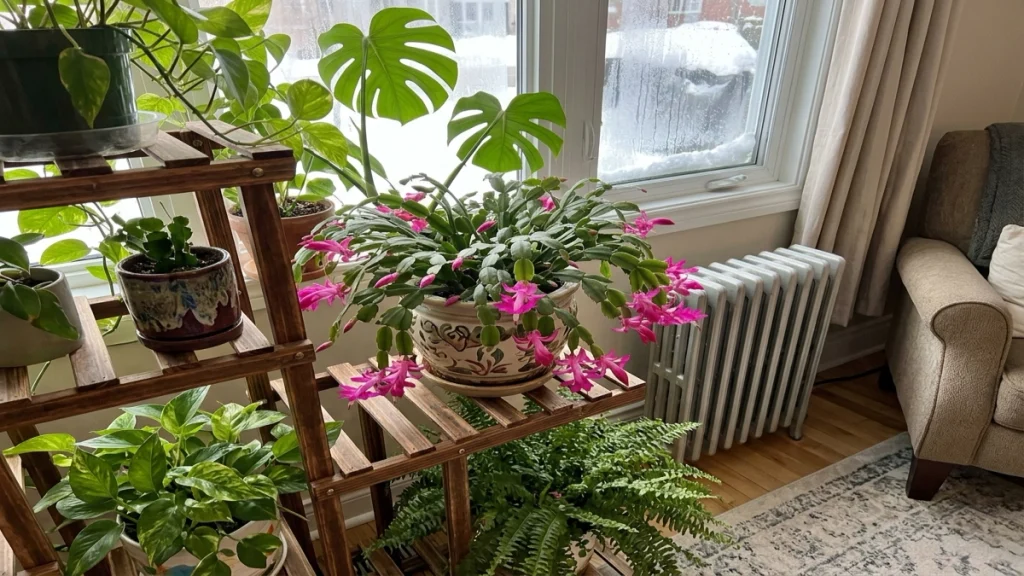
Central heating vents, wood stoves, cold windowpanes, and entry doors create sharp temperature drops and dry air currents. A plant placed too close to an active radiator will lose moisture faster than its fine root system can pull water from the soil. Conversely, leaving stem segments pressed directly against icy window glass in winter causes cell walls to collapse, resulting in blackened, soggy stem tips.
Aim for a baseline ambient temperature between 65°F and 75°F (18°C to 24°C) during active spring and summer growth. Keep the plant at least 3 feet (90 cm) away from supply vents, baseboard heaters, space heaters, and exterior doors that open frequently.
Relative air humidity in modern heated homes frequently drops below 30% during winter months. As an epiphyte, Schlumbergera thrives best when humidity stays between 40% and 60%. You do not need a commercial greenhouse setup to achieve this. Placing the container over a shallow tray filled with river pebbles and water—ensuring the bottom of the pot rests above the water level—creates a localized zone of rising moisture without soaking the roots. Grouping your cactus near other leafy houseplants naturally boosts humidity through collective transpiration.
Identifying Your Specific Plant: Christmas vs. Thanksgiving vs. Easter Cactus
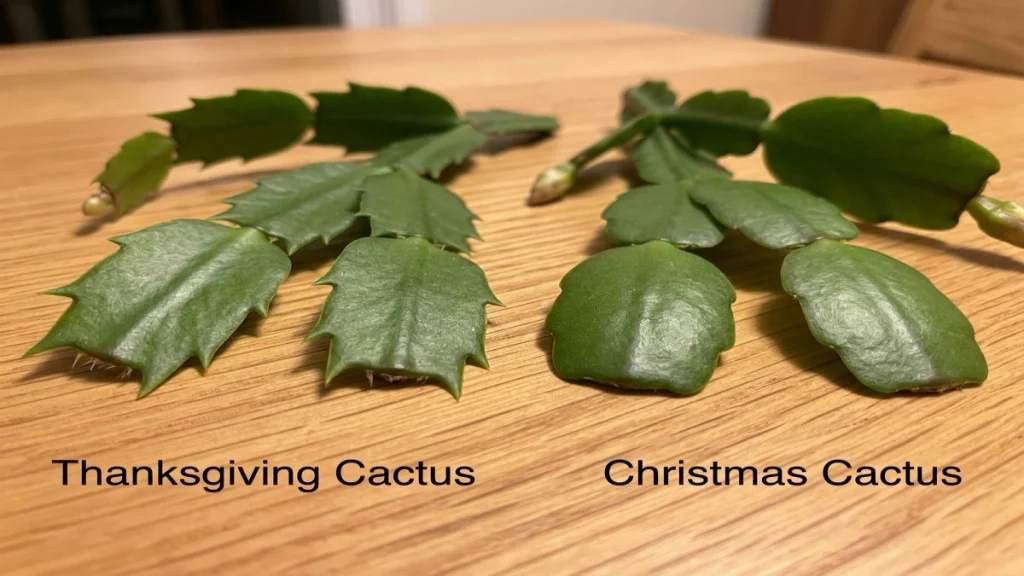
Many indoor growers struggle with bloom timing because they purchased a plant labeled as a Christmas cactus that is actually a closely related relative. Three distinct holiday cacti are commonly sold in retail nurseries:
- Thanksgiving Cactus (Schlumbergera truncata): Features sharply pointed, saw-tooth projections along the margins of each stem segment. It blooms earlier in the season, typically from late October through November, producing asymmetric, double-tiered flowers held horizontally.
- Christmas Cactus (Schlumbergera x buckleyi or S. bridgesii): Displays smooth, rounded, teardrop-shaped scallops along the segment margins. Branches arch downward gracefully, carrying symmetrical flowers that hang down toward the floor in late December or January.
- Easter Cactus (Rhipsalidopsis gaertneri or Shaticala gaertneri): Possesses rounded stem segments with small bristle-like hairs at the segment joints. It blooms in early to mid-spring with star-shaped flowers that open wide during daytime hours.
Knowing exact species identification prevents panic when a plant flowers in November instead of late December. Care requirements regarding light placement and well-draining soil remain nearly identical across all three groups.
The Room-by-Room Placement Guide
Every room presents distinct environmental conditions. Here is how to evaluate specific rooms in your house for plant placement:
| Room Location | Lighting Environment | Humidity & Draft Conditions | Placement Verdict |
| Living Room | Variable depending on window orientation; often offers broad ambient light. | Usually dry in winter due to forced-air heating or fireplaces. | Excellent, provided the pot sits 3 feet back from windows and far from heating vents. |
| Bathroom | Often limited by small, frosted, or high-set windows. | Consistently high humidity from showers and baths. | Conditional; great for humidity, but only viable if light exposure is sufficiently bright. |
| Kitchen | Frequently features large sunny windows over sinks or countertops. | Good ambient moisture, but prone to cooktop heat spikes and drafts. | Good, as long as the plant is kept clear of stovetops, ovens, and cold exterior doors. |
| Bedroom | Often kept cooler at night; lighting depends on window curtain usage. | Moderate humidity; gentle, undisturbed environment. | Excellent, especially for dark-period bud initiation in autumn months. |
If you ever have specific questions about a tricky room setup in your home, feel free to reach out directly through my contact page.
Triggering Autumn Blooms: The Dark Period and Temperature Switch
To encourage tight clusters of flower buds in autumn, Schlumbergera requires a distinct seasonal shift. In their native Brazilian forest home, decreasing day length and cooler night temperatures signal the start of the bloom cycle.
Starting in mid to late September, your plant needs two specific conditions for roughly six consecutive weeks:
- Uninterrupted Darkness: The plant requires 12 to 14 hours of continuous, total darkness every single night. Even brief exposure to artificial room lighting, hallway lamps, or streetlights during this window can interrupt the hormonal signal and delay bud formation.
- Cooler Night Temperatures: Ambient night temperatures should drop to between 50°F and 60°F (10°C to 16°C).
An unused guest bedroom, a quiet home office where lights are turned off at sunset, or a cool sunroom that stays above freezing make ideal autumn locations. If your main living space stays illuminated late into the evening, cover the plant with a breathable cardboard box or dark cloth from 6:00 PM to 8:00 AM every night.
Once small pea-sized flower buds lock into place at the tips of the stem segments, keep the pot in one location. Moving the plant to a different room, rotating it drastically, or exposing it to dry heat at this critical stage often causes bud blast—a frustrating condition where immature buds turn yellow and drop off before opening.
Troubleshooting Placement Issues: Symptoms to Causes to Solutions
When a Christmas cactus is unhappy with its environment, its stem segments and foliage communicate stress clearly. Use this quick reference guide to diagnose placement issues based on observable symptoms:
- Symptom: Stem segments turn reddish-purple or crimson across upper surfaces.
- Likely Cause: Excess exposure to direct solar radiation (sun scorch).
- What to Check: Check if direct midday or afternoon sun hits the foliage without filtering.
- What to Change: Move the container 2 to 3 feet (60 to 90 cm) further back from the window or install a sheer fabric shade.
- Symptom: Dull, wrinkled, thin, or leathery stem segments that feel limp.
- Likely Cause: Dehydration from root loss (overwatering/root rot) or under-watering caused by dry heater drafts.
- What to Check: Inspect soil moisture deep in the pot and check for active heating vents blowing dry air directly onto the plant.
- What to Change: Relocate the plant away from heat drafts; adjust watering frequency to ensure soil dries out slightly between waterings.
- Symptom: Green flower buds drop off the plant before opening (bud drop/blast).
- Likely Cause: Rapid changes in ambient temperature, sudden lighting changes, or cold drafts.
- What to Check: Check if the plant was moved after buds formed or if it sits near an exterior door or drafty window frame.
- What to Change: Keep the plant in a fixed location once buds form; seal drafty window gaps and avoid moving the pot until flowering finishes.
- Symptom: Pale, elongated, thin stem segments with weak, floppy growth.
- Likely Cause: Insufficient light exposure over an extended period.
- What to Check: Measure the distance from the nearest window and assess room brightness on overcast days.
- What to Change: Gradually transition the plant closer to an east or north window over a 7-to-10-day period.
For comprehensive details on how we protect your personal data when navigating our plant guides, you can view our privacy policy.
Soil Mix, Potting, and Seasonal Care Essentials
Correct placement works hand-in-hand with proper potting media and seasonal care. Because Schlumbergera roots require constant oxygen access, planting them in dense, heavy potting soil inevitably leads to root decay.
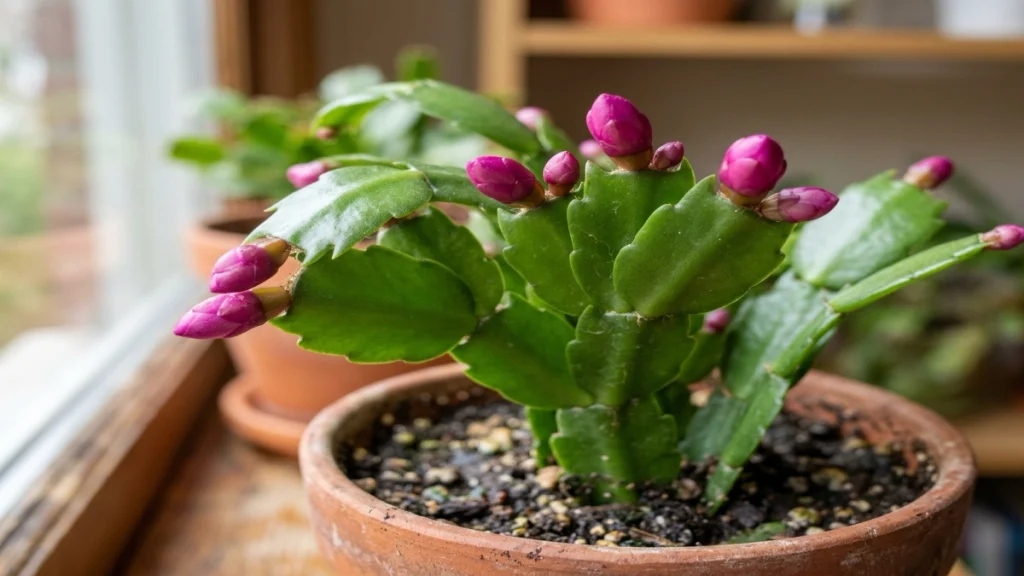
I use a simple, airy mix containing equal parts organic potting soil, coarse perlite, and orchid bark. This open structure allows water to drain freely while holding gentle moisture around fine feeder roots. Choose pots made of breathable unglazed terracotta with functional drainage holes at the bottom. These plants thrive when slightly root-bound; standard containers only require repotting every three to four years in spring.
Follow this general care calendar throughout the year:
- Spring (March – May): Active growth resumes. Move the plant to its bright summer location. Resume light feeding using a balanced water-soluble fertilizer diluted to half strength once a month.
- Summer (June – August): Fast stem development. Maintain consistent moisture, letting the top inch (2.5 cm) of soil dry out between waterings. Keep away from harsh midday sun.
- Autumn (September – November): Bud initiation phase. Reduce watering frequency slightly and introduce cool 50°F to 60°F (10°C to 16°C) nights with 12 to 14 hours of darkness. Discontinue all fertilizer applications.
- Winter (December – February): Blooming and post-bloom rest. Maintain stable room temperatures around 65°F to 70°F (18°C to 21°C). Water sparingly while flowering. After flowers drop, allow the plant a quiet 30-day dormant rest with reduced watering in a cool spot.
Horticultural extension specialists at the University of Florida IFAS Extension emphasize that tropical epiphytes require loose, airy soil substrates to prevent root asphyxiation during indoor cultivation. Similarly, research provided by the Royal Horticultural Society notes that proper night-length management is the single most critical factor for reliable indoor flowering in Schlumbergera hybrids.
Honest Mistakes I Have Made Over 10 Years
Over ten years of growing Schlumbergera in Vermont winters, I have made nearly every mistake possible. Learning what not to do is often more helpful than following perfect theoretical rules.
Early on, I placed a blooming plant directly on an uninsulated wooden windowsill to show off its bright magenta flowers. Outdoor winter temperatures plummeted to -5°F (-20°C), chilling the glass and freezing the outer branches. By morning, half the plant was mush. Now, I always maintain at least a 6-inch (15 cm) buffer between foliage and winter glass.
Another mistake was over-correcting for dry indoor winter air by overwatering soil. I thought damp soil would compensate for low humidity. Instead, the roots suffocated in cold, soggy potting media, leading to severe root rot. I had to take healthy tip cuttings to salvage the plant. I now keep the soil leaner and drier during cold months, relying instead on pebble trays for local humidity.
Reviewing our full terms and conditions gives additional insight into how we structure our educational content for readers.
Realistic Timeline: What to Expect After Moving Your Plant
Plants respond to environmental changes slowly. Expecting overnight results leads to unnecessary adjustments that stress the plant further. Here is a realistic recovery timeline after adjusting your plant’s location:
- Days 1 to 7: The plant adjusts to new light angles and air movements. Stem segments may look unchanged or show slight softening as water balance stabilizes. Avoid moving the pot during this week.
- Weeks 2 to 3: Foliage color normalizes. Sun-scorched reddish areas slowly fade back toward green, and water uptake stabilizes.
- Weeks 4 to 6: If moved to support autumn bud initiation, tiny pinhead-sized buds should begin appearing at the tips of healthy phylloclades.
- Months 2 to 3: Buds grow, develop deep color, and open into full blooms. Maintain stable light and water during this flowering period.
When a Plant Is Beyond Saving
While Schlumbergera are resilient, severe root damage can sometimes progress too far for recovery. If every stem segment turns limp, gray-green, and detaches at the soil line with a soft, foul-smelling root base, the root system has collapsed completely due to advanced root rot.
When this happens, do not toss the entire plant out. Look for firm, plump, green segments at the outer tips of the branches. Snap off healthy 3-to-4-segment sections cleanly at the natural joints. Let the open wounds callus in air for 24 hours, then insert the bottom segment halfway into a fresh, damp mix of equal parts perlite and peat moss. Keep the cutting in bright, indirect light. Within three to four weeks, new roots will sprout, allowing you to restart a healthy plant.
Frequently Asked Questions
Can I put my Christmas cactus outside during summer?
Yes, moving your plant outdoors during late spring and summer can promote strong growth. Place it in a shaded spot under a porch roof, patio overhang, or dense tree canopy where it receives bright ambient light without direct sun. Bring the plant back indoors before autumn night temperatures drop below 50°F (10°C).
Can a Christmas cactus live in a room without windows?
No, a Christmas cactus cannot survive long-term in a windowless room relying solely on standard incandescent household lighting. If your space lacks natural windows, you must supply 12 to 14 hours of daily illumination using a full-spectrum LED grow light positioned 12 to 18 inches (30 to 45 cm) above the foliage.
Why are the leaves on my Christmas cactus turning red or purple?
Reddish or purple coloration on stem segments indicates sun stress or excess ultraviolet exposure. This occurs when the plant receives harsh direct sunlight, particularly through south- or west-facing windows. Move the plant further back into the room or filter the light with a sheer curtain to allow the foliage to return to its natural green color.
Should I move my Christmas cactus while it is blooming?
It is best to leave your plant in a fixed location once flower buds form and begin expanding. Moving, rotating, or repositioning the pot during the blooming phase introduces subtle changes in light and draft patterns, which often triggers bud drop before flowers fully open.
Leave a Reply